Why Business Ideation Matters Now
In crowded markets, growth rarely comes from “more of the same.” Business ideation—the structured process of generating, refining, and validating opportunities—helps small and medium businesses (SMEs) find profitable, brand-consistent directions faster and with less risk. Done well, ideation connects three realities:
- Customer jobs, pains, and gains (what people actually need);
- Your brand’s credible strengths (what you can uniquely deliver);
- Market timing and channel dynamics (where demand is moving, how attention is won).
This article offers a practical, consultant-grade framework you can apply immediately—especially useful for teams focused on branding, creative development, and sustainable SME growth.
The Four-Stage Business Ideation Framework
1) Discover: Turn Noise into Insight
Goal: Build a shared understanding of unmet needs worth solving.
- Jobs-to-Be-Done interviews: Ask customers when they last tried to achieve an outcome, what triggered it, what “success” looked like, what blocked it. Extract repeated patterns.
- Problem Framing Canvas:
- User segment → core job → frustrations → current alternatives → desired outcomes → willingness to pay.
- Brand Reality Check: What do you already do credibly? Which promises can your brand make—and keep—without heavy reinvention?
Deliverables: 3–5 insight statements like: “Independent retailers want a faster way to plan Instagram content that feels on-brand without hiring an agency.”
Tip: Prioritize insights where your brand has authority (case studies, expertise, assets) to shorten the path to trust.
2) Generate: Produce Options on Purpose
Goal: Create a portfolio of differentiated, brand-aligned ideas.
Use three quick lenses:
- SCAMPER your current offerings: Substitute, Combine, Adapt, Modify, Put to other use, Eliminate, Reverse.
- Blue Ocean Moves (micro-scale): Remove a costly industry feature customers do not value; add a unique benefit competitors ignore.
- Experience Hooks: Design ideas around one standout moment—speed, simplicity, reassurance, or status. (Brands win when one moment feels unmistakably you.)
90-Minute Sprint Workshop (remote-friendly):
- Warm-up (10 min): “How might we…” prompts tied to your insights.
- Diverge (25 min): Silent sketching—no pitch, just headlines + quick flows.
- Gallery walk (15 min): Dot-vote on “value,” “brand fit,” “feasibility.”
- Converge (25 min): Combine top ideas into 2–3 concept cards.
- Premortem (15 min): “It failed in 6 months—why?” Capture risks early.
Deliverables: 2–3 Concept Cards (problem, value proposition, key features, proof points, how it strengthens the brand).
3) Validate: Reduce Risk Before You Scale
Goal: Replace opinions with evidence.
- Value Proposition Smoke Tests:
- Create a one-page landing with a clear promise and CTA (“Join the waitlist,” “Request a demo”).
- Run targeted traffic (e.g., LinkedIn/Instagram) to measure Conversion to Interest (CTI).
- Offer–Price Fit: Use a Willingness-to-Pay ladder (survey ranges + pilot discounts) to find price walls without eroding perceived value.
- Prototype Signals:
- Concierge MVP: Manually deliver the service to a handful of clients to learn operations.
- Fake-Door Features: Track clicks on a “coming soon” module to gauge demand.
- Qualitative Debriefs: 8–10 interviews focusing on why people did or didn’t convert (not what they “might” do someday).
Validation Benchmarks (starter targets):
- CTI > 8–12% on qualified traffic;
- ≥ 5 paid pilots or 10 pre-orders (for SMB B2B);
- Cost-per-lead within 50–70% of your current high-intent CPL.
4) Scale: Turn a Validated Idea into Repeatable Growth
Goal: Create a go-to-market motion that compounds.
- Positioning Statement (internal):
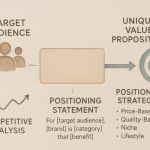
For [target segment] who struggle with [job/pain], [brand] provides [core outcome] through [key mechanism], unlike [primary alternative], we [differentiator tied to proof]. - Proof Architecture: Case studies, quantified outcomes, authority content (webinars, whitepapers), and partner endorsements.
- Offer Ladder: Entry (low friction), Core (profit center), Expansion (retainers, add-ons).
- Operations Readiness: Standard operating procedures, service-level metrics, and feedback loops to keep quality consistent as you grow.
The Ideation Scorecard (ICE + Fit)
When options look equally promising, score each concept:
| Dimension | Question | Score 1–5 |
|---|---|---|
| Impact | If it works, how much will it move revenue or retention? | |
| Confidence | How strong is the evidence (data + proof points)? | |
| Ease | How quickly/cheaply can we ship a credible v1? | |
| Brand Fit | Does it reinforce our positioning and credibility? | |
| Defensibility | Advantage from IP, process, relationships, data? |
Sum to rank. If two ideas tie, prefer the one with higher Brand Fit—it compounds trust and lowers CAC over time.
Ten Consultant-Grade Prompts to Spark Business Ideation
- “What do our best customers hack together today that we could productize?”
- “Which step in the buyer journey causes the most anxiety, and how could we remove it entirely?”
- “If we had to deliver the same outcome with half the steps, what would we cut or automate?”
- “Which adjacent job (before/after our service) do clients pay for elsewhere?”
- “What premium version would a time-poor client buy tomorrow?”
- “What no-frills version would a price-sensitive client accept if trust remained high?”
- “Which recurring pain could become a subscription or retainer?”
- “What guarantee could we credibly make that competitors cannot?”
- “Which partner already has our ideal audience, and what co-created offer would make them look good?”
- “Which insight do we uniquely own (data, method, story) that could anchor thought leadership?”
Brand-First Ideation for SMEs (Marketing & Creative Services Examples)
- Content Accelerator for SMEs: A monthly “done-with-you” program combining editorial strategy, brand voice alignment, and AI-assisted production with human editing. Value: speed + consistency; Proof: samples, before/after analytics.
- LinkedIn Authority Sprint (30 days): Executive ghostwriting + profile optimization + comment strategy + micro-webinars. Value: reputation and inbound; Proof: lead quality, connection growth.
- Reputation Insurance Plan: Monitoring + crisis playbooks + rapid content kits. Value: risk reduction; Proof: response time SLAs, media relationships.
- Conversion-Ready Brand Kits for Startups: Visual identity, voice guide, landing templates, and CTA library shipped in two weeks. Value: go-to-market speed; Proof: time-to-first-lead metrics.
Each example can be validated with a concierge MVP, priced via tiered offers, and scaled through case-study-led selling.
Five-Day Ideation Sprint (Field-Tested Schedule)
Day 1 – Insights & Framing
Synthesize customer jobs and pains; choose opportunity areas; define success metrics.
Day 2 – Diverge & Concept
Run the 90-minute workshop; produce 2–3 concept cards with clear promises.
Day 3 – Prototype & Smoke Test
Build a landing page, a simple explainer, and a CTA (waitlist/demo). Launch targeted traffic.
Day 4 – Evidence & Iteration
Review CTI, interview fast responders, refine copy/offers, adjust price anchors.
Day 5 – Decision & Roadmap
Use the Ideation Scorecard; commit to one concept; define MVP scope, proof points, and a 30-day GTM plan.
Pricing and Packaging: Make Value Legible
- Anchor on outcomes, not hours.
- Offer three tiers: Essential (low risk), Growth (core value), Elite (speed/priority/extra proof).
- Add risk-reversal where credible (milestone-based refunds, performance bonuses, or guarantees tied to metrics you can influence).
- Keep expansion paths visible: workshops → retainers, audits → implementation, pilots → annual agreements.
Metrics That Matter (and Keep You Honest)
- CTI (Conversion to Interest): % of visitors who signal intent.
- SQ (Sales Qualified) Rate: % of leads that match ICP and have budget/timing.
- Time-to-First-Value: How quickly a new client experiences the promised outcome.
- Retention/Expansion: Renewal rate, expansion revenue per account.
- Brand Trust Signals: Testimonials acquired per quarter, media mentions, expert endorsements.
Tie your ideation bets to one primary metric for 30 days. If it moves the metric, keep going; if not, pivot or prune.
Common Pitfalls (and Simple Fixes)
- Pitfall: Asking “What do you want?” in surveys.
Fix: Observe behavior and ask about the last time the problem happened. - Pitfall: Falling in love with features.
Fix: Sell outcomes; prototype the one proof moment that makes your value unmistakable. - Pitfall: Scaling before proof.
Fix: Wait for consistent CTI + repeatable delivery + at least two reference customers. - Pitfall: Confusing novelty with differentiation.
Fix: Differentiate on clarity, speed, assurance, or status—not gimmicks.
Frequently Asked Questions (FAQ)
What is business ideation in simple terms?
It is a systematic approach to finding, shaping, and proving new ways your business can create value and grow—before you commit heavy resources.
How is it different from brainstorming?
Brainstorming generates ideas; ideation moves ideas through validation (evidence) and positioning (brand fit), resulting in a confident go-to-market plan.
How long should ideation take?
A focused SME team can run a five-day sprint to pick one validated direction for a 30-day MVP.
Do I need a big budget to validate?
No. Start with low-cost landing pages, small traffic tests, and concierge delivery. Invest more only after early signals are strong.
Action Checklist (Copy-and-Use)
- Choose one customer job you can credibly own.
- Write a Positioning Statement (internal).
- Create two Concept Cards and shortlist one with the Scorecard.
- Launch a smoke-test landing and drive targeted traffic for 5–7 days.
- Interview 8–10 respondents—capture quotes and objections.
- Define a two-week MVP and a 30-day GTM with one core metric.
- Collect proof (testimonial, before/after metrics) before scaling spend.
Internal Linking Recommendations (SEO)
From this page, link to:
- Brand Positioning (guide or service page)
- Customer Research / JTBD Interviews (how-to)
- Landing Page Optimization (CRO article)
- Case Studies (proof library)
And link back to this guide from:
- Services → Business Consulting / Creative Development
- Blog posts on productization, ICP, pricing, and GTM.
Final Thought
Business ideation is not a once-a-year workshop—it is a repeatable capability. For SMEs, the discipline to align insights, brand credibility, and validation creates a compounding edge: lower acquisition costs, faster trust, and growth you can sustain.